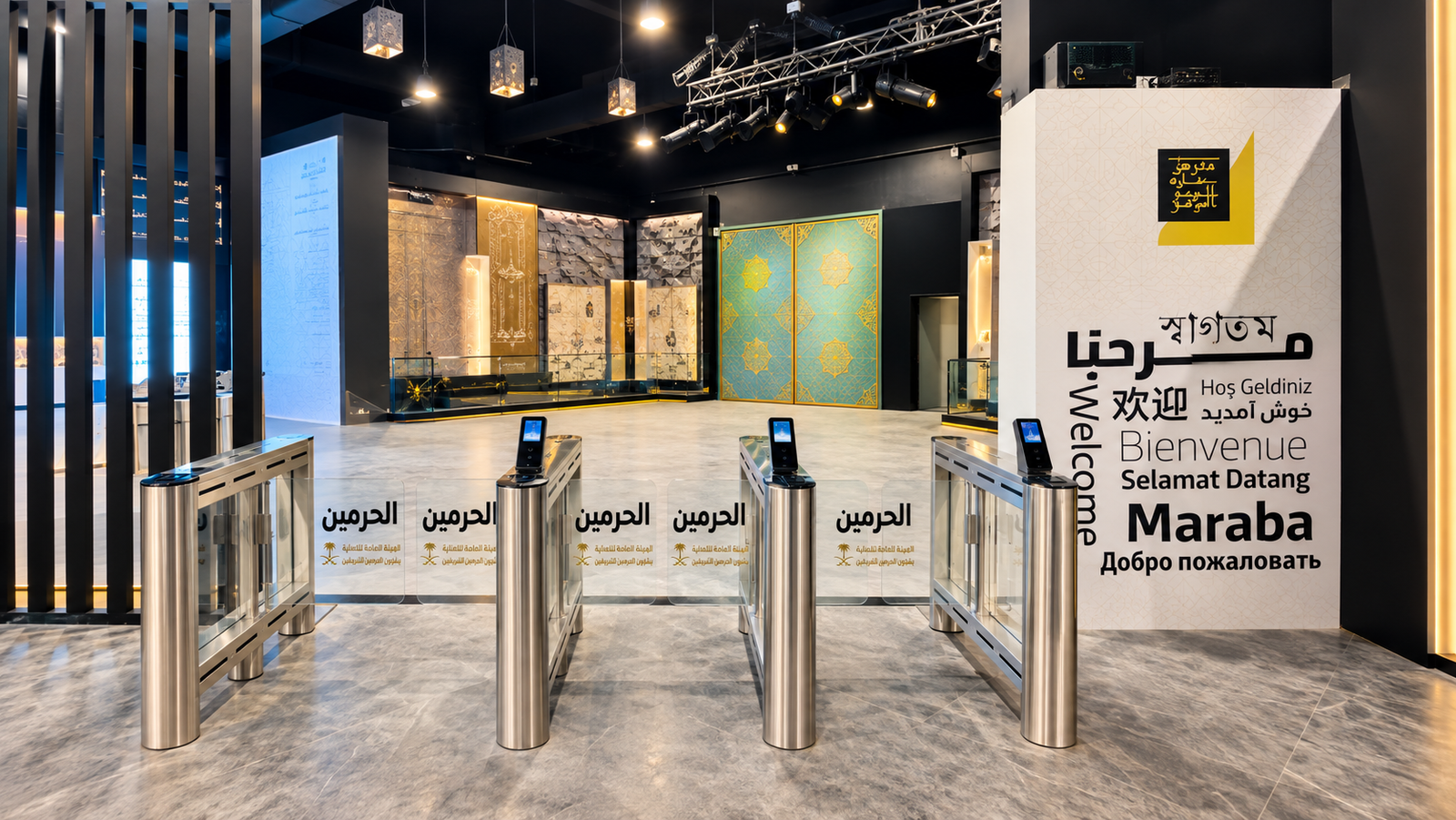
Securing Sacred Heritage: Intelligent Access Control & Visitor Management at the Exhibition of the Two Holy Mosques Architecture
From the moment a visitor books an appointment online to the moment they enter the exhibition, every step is designed to be simple, secure, and seamless. At one of the Kingdom’s most significant cultural exhibitions, technology works quietly behind the scenes to create a smooth and respectful visitor experience.
Project at a Glance
The solution brings together Matrix Access Control, Matrix Visitor Management, Matrix ARGO Face Recognition, and Fastlane Speed Gates to create a connected visitor journey. Together, these technologies help manage visitor appointments, verify identities, control access, and provide fast, secure entry—creating a seamless experience from online booking to authorised entry.
Executive Summary
The Exhibition of the Two Holy Mosques Architecture is a remarkable cultural destination in the Kingdom, showcasing the rich architectural heritage of Al-Masjid Al-Haram and Al-Masjid An-Nabawi. With visitors arriving from different countries and backgrounds, the exhibition needed an access experience that was as welcoming and well organised as the exhibition itself—fast, secure, respectful, and completely digital.
To meet this need, Al Harmain Group partnered with AIED to create an integrated Visitor Management and Access Control solution. The system connects Al Harmain Group’s online appointment booking platform with Matrix Visitor Management and Matrix Access Control through secure REST APIs.
The visitor journey starts online. After booking an appointment, each visitor receives a QR-coded, time-bound credential that can be used when they arrive at the exhibition. At the entrance, Matrix ARGO Face Recognition terminals, integrated with Fastlane Speed Gates, verify the visitor and provide authorised access. Employees and contractors can use the same gates through facial recognition, while Matrix Access Control centrally manages access across the facility.
The result is a smooth, contactless journey from appointment to entry. Manual ticket checks are reduced, visitor capacity and scheduled time slots can be managed automatically, and Al Harmain Group gains a reliable, auditable record of everyone entering the exhibition. Most importantly, the technology works quietly in the background, allowing visitors to focus on the cultural experience rather than the access process.
“A visitor’s journey should feel as thoughtfully designed as the exhibition itself. The technology needed to stay in the background while making every step simple and effortless.”
About the Customer
Al Harmain Group curates and operates the Exhibition of the Two Holy Mosques Architecture, a permanent cultural exhibition in Makkah Al-Mukarramah that celebrates the architectural history, craftsmanship, and evolution of Al-Masjid Al-Haram and Al-Masjid An-Nabawi.
The exhibition welcomes a diverse mix of pilgrims, tourists, researchers, and cultural visitors throughout the year. Visitor numbers can change significantly depending on the season, day, and time, making efficient visitor flow and access management particularly important.
Operating in such an important religious and cultural environment, Al Harmain Group needed more than a conventional entry system. The goal was to create an access experience that was secure and organised, yet welcoming and respectful—matching the sense of dignity associated with the exhibition and the significance of its subject.
AIED’s integrated solution was designed to support exactly that: technology that strengthens security and operational control while remaining simple and unobtrusive for every visitor.
Customer Challenges
Managing access to a major cultural exhibition comes with its own set of challenges, particularly when visitor numbers can change significantly throughout the day and during peak seasons. Al Harmain Group needed an access experience that could keep up with these demands while remaining simple and welcoming for every visitor.
Managing Busy Visitor Flow
During peak periods, large numbers of visitors can arrive within short timeframes. Manual ticket checks and paper-based passes made it difficult to process visitors quickly and accurately, potentially leading to queues and delays at the entrance.
Connecting Online Bookings with Physical Entry
Visitors could book their appointments online, but the booking platform was separate from the physical entry system. There was no automated way to verify a visitor’s appointment when they arrived, creating additional manual work and making it harder to ensure that only valid bookings were accepted.
Managing Different Types of Users
The exhibition needed to accommodate booked visitors, employees, and contractors, all using the same entry points. However, each group required different credentials and access permissions. The challenge was to manage these different user groups without making the entry process complicated.
Improving Visibility and Control
Security and operations teams needed better visibility into who was entering the exhibition, how many people were inside, whether visitors were arriving within their assigned time slots, and overall entry activity. A centralised system was needed to provide this information in a clear and timely manner.
Keeping Technology Simple and Respectful
Because the exhibition is connected to an important religious and cultural heritage, the technology needed to be carefully integrated into the visitor experience. It had to be fast, reliable, and unobtrusive, while remaining easy to use for visitors of different ages, languages, and levels of familiarity with digital technology.
The goal was clear: strengthen security and operational control without allowing technology to get in the way of the visitor experience.
Business Objectives
Al Harmain Group wanted to create a visitor access experience that was secure and efficient while removing unnecessary manual steps. The key objectives were to:
- Digitise the complete visitor journey: From online appointment booking to entry at the exhibition, with minimal manual intervention.
- Automatically verify appointments: Ensure visitors enter only within their assigned time slots, while helping prevent the venue from exceeding its capacity.
- Effortless employee and contractor access: Enable facial recognition for staff, while keeping their access process separate from the visitor QR-based journey.
- Unified platform: Bring access management, reporting, and audit records together under one centralised access control platform.
- Dignified experience: Create a fast, smooth, and dignified entry experience that reflects the importance of this landmark cultural and religious exhibition.
Why AIED
AIED was chosen for its experience in delivering integrated access control, visitor management, and ANPR solutions for large-scale enterprise and government environments across Saudi Arabia.
Rather than treating the project as separate software and hardware deployments, AIED brought the complete solution together. This included API integration, Matrix access control and visitor management platforms, and Fastlane speed gate technology, with AIED responsible for system design, integration, installation, configuration, and commissioning.
Proposed Solution
AIED designed a unified access solution built around three key elements: connecting appointments to visitor credentials, verifying users at the entrance, and centrally managing access across the facility.
The existing online appointment platform remains the starting point for visitors. Once an appointment is confirmed, AIED’s integration layer securely connects the booking system with Matrix Visitor Management through REST APIs. The system then generates a unique, time-limited QR credential for the visitor.
When the visitor arrives at the exhibition, the credential can be verified at the entrance through Matrix ARGO Face terminals. For enrolled employees and contractors, facial recognition provides a convenient, contactless authentication method.
Once the visitor or authorised personnel are successfully verified, the authentication result is communicated to the Fastlane speed gates, which allow entry only when the required access conditions are met.
Behind the scenes, Matrix Access Control provides centralised control across the facility. It manages user roles, access schedules, anti-passback rules, credentials, and audit records, giving security and operations teams a clear view of access activity.
The result is a connected journey where booking, verification, access control, and entry work together as one system—making the experience faster and more secure while keeping the technology largely invisible to visitors.
Complete Solution Architecture
To create a smooth experience from online booking to physical entry, AIED designed the solution as four connected layers. Each layer has a specific role, while secure APIs keep information moving between the systems without relying on manual data entry or disconnected integrations.
Booking Layer
The journey begins with Al Harmain Group’s existing online appointment platform, where visitors select their preferred date and time and book their visit.
Integration Layer
Once an appointment is confirmed, secure REST APIs transfer the relevant booking information to Matrix Visitor Management. This keeps visitor and appointment information synchronised between the online booking system and the access environment.
Authentication Layer
At the exhibition entrance, Matrix ARGO Face terminals handle user authentication. Visitors scan their time-bound QR credentials, while enrolled employees and contractors use high-speed facial recognition. Once verified, the system signals the Fastlane speed gate to open.
Governance Layer
At the centre of the solution is Matrix Access Control, which provides centralised management of users, credentials, access schedules, permissions, anti-passback rules, and complete audit records.
System Components
The solution combines several key technologies to manage the complete visitor and access journey:
Appointment Booking Platform
Al Harmain Group’s public-facing platform for scheduling visits, selecting time slots, and managing appointment allocations.
Matrix Visitor Management
Manages visitor pre-registration, appointment information, visitor scheduling, and digital QR credential lifecycle.
Matrix Access Control
Provides centralized control over credentials, user roles, access schedules, anti-passback rules, and activity logs.
Matrix ARGO Face Terminals
Supports both dynamic QR-based visitor authentication and deep-learning facial recognition for authorized personnel.
Fastlane Speed Gates
State-of-the-art physical access barriers providing secure, rapid, and elegant pedestrian entry upon approved verification.
AIED Integration Middleware
Custom secure REST API integration connecting the online booking platform directly with Matrix systems without manual intervention.
Hardware Infrastructure
- Matrix ARGO Face: Contactless authentication for both visitor QR scans and staff face matching.
- Fastlane Speed Gates: Secure, high-throughput motorized barrier gates opening only upon valid authentication.
- Network & Power: High-grade structured cabling, PoE switching, and enterprise UPS backup for uninterrupted operations.
Software Infrastructure
- Matrix Visitor Management: Pre-registration, visitor tracking, QR credential generation, and appointment history.
- Matrix Access Control: Central policy manager for user roles, schedules, door controllers, and audit trails.
- AIED Integration Middleware: Real-time bi-directional REST API synchronization for appointments, reschedules, and cancellations.
End-to-End Integration Architecture
This connection eliminates the gap between online appointment bookings and physical entrance validation. Updates or cancellations synchronize immediately to ensure gates reflect real-time booking status.
The Complete Visitor Journey
The visitor experience has been designed to be simple, respectful, and effortless from beginning to end:
Book an Appointment
The visitor selects a suitable date and time through Al Harmain Group’s online booking platform.
Appointment Information Is Shared Automatically
The confirmed booking is securely transferred to Matrix Visitor Management through AIED’s integration layer.
Visitor Registration
The visitor's details are registered automatically in the visitor management database.
QR Credential Is Created
A digital, encrypted QR credential is automatically generated for the confirmed appointment.
Time-Based Access Is Applied
The credential is calibrated to the visitor's approved appointment time window, preventing early or expired access.
Visitor Arrives at the Exhibition
The visitor approaches the entrance lanes and presents their digital QR code to the Matrix ARGO Face terminal.
Credential Is Verified
The system validates credential integrity and confirms the appointment window and venue capacity conditions in milliseconds.
Fastlane Gate Opens
Upon successful authentication, the Fastlane speed gate opens gracefully, welcoming the visitor inside.
Entry Is Recorded
The access event is instantly timestamped and logged, creating a clear, traceable record for security and operations.
Staff & Contractor Fast-Track: For enrolled employees and contractors, the exact same entry infrastructure supports seamless facial recognition, providing a fast, contactless authentication method without disrupting the visitor QR-based journey.
Technical Features
The solution integrates comprehensive visitor management, access control, biometrics, and automation capabilities into one unified platform:
Centralised Access Control
Provides a single pane of glass to manage credentials, user profiles, privilege roles, and access schedules across the facility.
Digital Visitor Management
Simplifies pre-registration, automated scheduling, visitor tracking, and digital credential distribution.
Multi-Credential Authentication
Supports secure dynamic QR verification for public visitors and contactless face recognition for authorized staff.
Time-Based QR Access
Ensures visitor credentials are valid strictly within the designated appointment time window, preventing unauthorized access outside booked hours.
Facial Recognition
High-accuracy, anti-spoofing facial recognition allows authorized employees and contractors to enter hands-free.
API Integration
Secure REST APIs ensure real-time synchronization between Al Harmain Group’s online booking engine and the access control core.
Role-Based Access (RBAC)
Enforces granular security privileges for different user categories: pilgrims, VIP visitors, contractors, and permanent staff.
Access Scheduling
Maintains strict schedule policies ensuring users only gain physical entry during their approved and scheduled time slots.
Anti-Passback Protection
Hard anti-passback rules prevent credential sharing, pass-back misuse, or repeated fraudulent entries on a single booking.
Detailed Audit Trail
Timestamped logging of all entry and authentication attempts provides immutable audit records for operations and security.
Dynamic Enrollment
Enables security personnel to easily enroll, modify, or de-register employee and contractor biometric profiles on demand.
Automatic Credential Expiry
Visitor QR passes instantly deactivate following departure or upon expiration of the scheduled visiting slot.
Security & Compliance Features
Security was engineered into every layer of the architecture rather than added as an afterthought:
Secure API
TLS-encrypted communication protects all sensitive data exchanged between the booking platform and Matrix.
Data Protection
Robust enterprise safeguards secure visitor identity and booking credentials throughout their transit and storage.
Audit Logging
Comprehensive event logs record operator actions, gate triggers, and authentication results with microsecond precision.
Role Administration
Administrative system privileges are partitioned according to defined operator and supervisor tiers.
Vulnerability Testing
The solution is designed to support ongoing cybersecurity assessments and penetration testing frameworks.
Privacy-Aware Design
Configured with strict data-minimisation principles when managing biometric features and visitor information.
Business Benefits
The integrated solution delivers tangible operational and cultural benefits for both visitors and venue management:
- Less manual work at the entrance: Digital credentials eliminate slow manual paper-ticket checks and paper pass issuing.
- Smoother visitor flow: Appointment-based access balances visitor arrivals throughout the day, preventing bottleneck congestion.
- One unified system: Visitors, staff, VIPs, and contractors are managed inside one connected access control ecosystem.
- Real-time visibility: Operations and security teams have an instant, live overview of venue occupancy and entry dynamics.
- Stronger accountability: Every single entry is authenticated and logged with high-integrity audit trails.
- A more comfortable visitor experience: Contactless scanning and rapid speed gates make entry serene, respectful, and unobtrusive.
Business Value Delivered
For Al Harmain Group, the project goes far beyond simply automating an entrance. It connects the entire journey—from booking an appointment online to recording the visitor's arrival.
The organisation now has a more connected access environment, a central platform for managing different user groups, and a reliable digital record of access activity. Most importantly, the technology works quietly in the background, allowing visitors to move through the entrance without unnecessary steps or delays.
Results Achieved
- An automated real-time bridge connecting the online booking engine with physical gates.
- Rapid, contactless pedestrian flow using QR authentication and Fastlane speed gates.
- Frictionless, touchless facial recognition for authorized personnel and contractors.
- Centralized administration across all user groups with centralized audit accountability.
- Enhanced operational capacity planning during peak religious and cultural seasons.
- Zero reliance on manual ticket checks, improving crowd management and safety.
Key Takeaways
Connect Booking & Access
Integrating online appointment slots directly with physical access gates eliminates manual errors and synchronizes changes instantly.
Tailor Authentication
Using QR codes for visitors and facial recognition for staff lets the same physical infrastructure serve distinct operational workflows.
Centralise Management
A single centralized platform provides comprehensive oversight, real-time occupancy counts, and unified compliance reporting.
Future Scalability
The solution has also been designed with future growth in mind. As visitor volumes increase or new entry points are introduced, additional Fastlane gates and ARGO terminals can be added without redesigning the entire integration architecture. New devices can continue to operate within the same centralised Matrix Access Control environment.
The integration approach can also be extended to support future Al Harmain Group venues, group bookings, additional visitor services, or new identity-verification requirements.
As the organisation grows, the same foundation can support expanded reporting and analytics, helping turn access data into useful operational insights.
Conclusion
For Al Harmain Group, the Exhibition of the Two Holy Mosques Architecture is more than a place to visit. It is a space dedicated to preserving and sharing an important part of the Kingdom's cultural and architectural heritage.
AIED's integrated solution brings together online appointments, visitor management, access control, facial recognition, and automated speed gates to create a visitor journey that is secure without feeling restrictive.
From the moment a visitor books online to the moment they walk through the gate, the process is connected, automated, and designed to feel effortless. Behind the scenes, Al Harmain Group gains greater control, visibility, and accountability. For visitors, the experience is much simpler: book, arrive, verify, and walk in.
“The best access technology is the kind visitors barely notice. They simply book their visit, arrive with confidence, and walk through the door—while the teams behind the scenes have the visibility and control they need.”